
Views: 0
For years, electric cars have been seen simply as vehicles that needed to be recharged from the home electrical grid. But technology has taken an interesting turn: now it's possible for the car to power the house.
This capability, known as bidirectional charging, is beginning to mark a turning point in how we manage our energy.
When the first commercial electric cars appeared, the equation was simple: the house charged the car. However, with the evolution of charging systems and the development of more powerful and efficient batteries, a powerful idea has emerged: allowing the vehicle's battery to return energy to the home when needed.
In Europe and the United States, the most widely used standard is CCS (Combined Charging System), and its latest evolution already allows this bidirectional flow. This opens the door to a much more dynamic relationship between car, home, and electrical grid.
Modern electric vehicles have high-capacity batteries designed to provide a range of several hundred kilometers. Using them as backup power systems is a perfectly logical consequence.
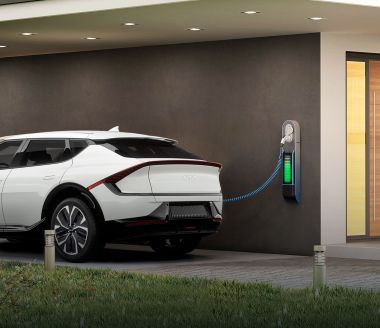
During peak demand or grid strain, the house can be temporarily powered by the car, reducing the load on the electrical system. The car acts as a kind of home battery.
When energy is cheaper or more abundant—for example, during daylight hours if solar panels are installed—the battery recharges without affecting the overall stability of the power supply.
This idea transforms the car into a high-capacity portable battery, useful not only for emergencies but also for optimizing electricity costs.
While it may seem like a somewhat futuristic vision, this is already happening. A significant example is being implemented in Menifee, a town in Southern California. There, a group of homes have been selected and equipped with solar panels capable of generating up to 13 kW of power. Each household has been provided with a Kia EV9, an electric SUV whose 12 kWh battery allows it to supply energy to the home when needed.
The project aims to study in detail how homes, solar panels, the electrical grid, and vehicles interact. The goal is to measure how much energy they capture, how much they consume, how much they return to the grid, and at what times.
The causes of peak demand, fluctuations, and the vehicle's impact as an energy buffer are also being analyzed.
This is a valuable test because it provides real-world data on different days, under varying weather conditions, and across different charging scenarios. Above all, it demonstrates that this technology is not a laboratory experiment, but a solution already being tested in real-world situations.
All of this aligns with an increasingly clear trend: building more resilient electrical grids capable of absorbing the fluctuations of modern consumption.
Integrating electric vehicles as active elements in the system—and not simply as loads—can significantly strengthen grid stability.
In the near future, millions of connected electric cars could function as a gigantic, distributed “energy buffer.” Each vehicle would be a small piece of the puzzle, contributing or absorbing energy as needed by the system.
There is still a long way to go. Improvements will be needed in technical regulations, safety standards, compatibility between manufacturers, and energy management technologies.
But the steps already being taken—such as the Menifee trials and similar ones in Europe and Asia—point toward a future where the relationship between cars and homes will be much closer.
This isn't just about electric mobility; it's about an energy revolution. A system where the car is not merely a means of transportation, but a tool to increase the autonomy, efficiency, and stability of our homes.
Everything indicates that we are heading in the right direction. And this new phase of energy independence could mark the beginning of a much more sustainable, flexible, and robust model.
 EN
EN  ES
ES