
Views: 0
The news hit like a bombshell at the end of October: Amazon, one of the largest companies on the planet, announced it will replace around 600,000 workers with robots in the coming years.
The company, with more than 1.5 million employees, plans to automate nearly 75% of its logistics operations, a step as ambitious as it is inevitable in the current technological race.
And although it sounds like massive layoffs, Amazon was clear: they won't eliminate current jobs, but they will drastically reduce future hiring. In other words: human work isn't disappearing, but it's stopping growing.
One thing we must recognize about Amazon: it has been straightforward. It hasn't hidden behind speeches about "digital transformation" or "technological synergies." It simply announced that robots will do much of the work. And the market, far from being scared, celebrated: shares rose from $213 to $221 in just four days.
This move reflects the cold logic of investors: if costs go down and productivity increases, the company is worth more.
Amazon has been preparing for this moment for years. Today, more than a million robots already work in its logistics centers around the world. The company not only uses them: it has its own robotics division and even participates in companies specializing in robots, automation, and artificial vision.
For years, Amazon has been replacing repetitive and physically demanding tasks with automated systems. From robots that move shelves in warehouses to mechanical arms capable of sorting packages with millimeter precision.
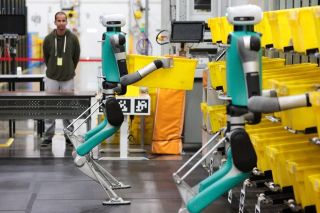
Now the company wants to accelerate that process. The goal: to automate 75% of its global logistics operations. And the reason is simple: reduce operating costs, improve service efficiency, and maintain its leadership in global e-commerce.
In 2023, Amazon had revenues of $574.8 billion and a profit of $30.425 billion. However, a large part of those profits come from its cloud division, AWS, not from its logistics division.
And therein lies the great challenge: making a global distribution network that delivers millions of orders daily with increasingly tight margins more profitable.
Robots, on the other hand, don't ask for raises, get sick, or need vacations. They operate 24/7, with precision and consistency. In a business where every second and every dollar counts, automation is the next logical step.
Amazon's move marks a turning point in the relationship between human labor and technology. If a company with more than 1.5 million employees can replace a third of its workforce with robots, other large companies will follow suit.
This doesn't necessarily mean mass unemployment, but it does mean a profound transformation of job profiles. Repetitive physical labor will give way to technical jobs, supervisory work, programming, or maintenance of automated systems.
In other words, robots won't eliminate all jobs, but they will profoundly change their nature.
And here an inevitable social and economic debate arises:
Are we prepared to train millions of workers in new skills?
Can labor and education policies keep pace with automation?
From a business perspective, Amazon's move makes perfect sense. Its success is based on efficiency, speed, and cost control. Advanced robotics allows packages to move faster, errors to be reduced, and margins to improve.
What may seem like a risky move to some today will be the new standard tomorrow. And let's not forget that robotics is maturing rapidly. Advances in sensors, AI, and autonomy make robots more versatile and economical than ever.
Amazon's decision isn't just business news: it's a clear sign of the direction the global economy is taking. Major automation is no longer science fiction; it's a corporate strategy.
But we must remember that, in the end, technology only makes sense if it improves people's lives. And that includes both customers who receive their orders within 24 hours and workers who must adapt to a world where robots are no longer assistants... but companions.
The challenge now will be to balance technological efficiency with social responsibility. A huge challenge lies ahead.
 EN
EN  ES
ES