
Views: 2
Amazon has just reached a technological milestone that speaks volumes about its vision for the future of logistics. In January of this year, it announced the installation of its one millionth robot, located in a logistics center in Japan. This is not just an impressive figure: it confirms a strategy that has been in place for over a decade.
For many years, Amazon has used robots to improve its internal operations. But there's an important distinction: Amazon doesn't just buy robots; it also designs and manufactures them, as it owns several companies specializing in robotics. This gives it a huge competitive advantage over its rivals.
It all began around 2012, when Amazon started installing robots from Kiva Systems, a company that was soon after acquired by the e-commerce giant itself. That decision marked a turning point in modern logistics.
Today, Amazon operates more than 300 facilities worldwide, and just a couple of years ago, it was already handling around 16 million deliveries daily. Maintaining that volume without automation would simply be impossible.
Robots for everything… and increasingly intelligent. Different types of robots coexist in its logistics centers, each with a very specific function:
. AGVs (autonomous guided vehicles) that move entire shelves and heavy loads.
. Robotic arms that sort, handle, and pack products.
. Autonomous mobile robots, like Proteus, capable of moving freely among people without the need for cages or enclosed routes.
This robotic ecosystem has grown at an impressive rate, reaching the symbolic number of one million active robots.
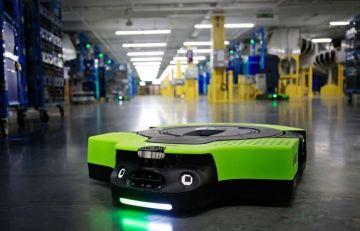
Now they face a new challenge: coordinating the chaos. With so many robots moving simultaneously, Amazon encountered an interesting “problem”: how to coordinate millions of daily movements without creating bottlenecks.
The answer has been technological. Amazon has developed an artificial intelligence-based system called Deep Fleet, designed to optimize the movement of robots within warehouses. The goal is clear: to reduce unnecessary travel, avoid interference, and further accelerate deliveries.
It's not just about having robots, but about making them work as a perfectly synchronized fleet.
Contrary to what many believe, Amazon has hardly laid off any people. Quite the opposite. In recent years, it has trained more than 600,000 employees in robotics, maintenance, and operation of these systems.
The reason is simple: a robot that's idle is useless. Without qualified personnel to supervise, repair, and optimize it, automation loses all its economic sense.
Amazon has understood this well: technology doesn't eliminate human work, it transforms it, although logically, automated systems require fewer people.
The speed with which Amazon delivers its orders is neither a matter of chance nor magic. Behind it all are multi-million dollar investments, long-term planning, and a firm commitment to robotics and artificial intelligence.
Everything is geared toward the same goal: reducing time, lowering costs, and maintaining its lead in global distribution. In this sector, those who stand still, disappear. Nothing is given away for free.
For those who want to see this technology in action, Amazon has released a very illustrative video:
The millionth robot is not the end of the road. It's just another step in a race that Amazon has been running… and winning… for many years.
 EN
EN  ES
ES