
Views: 0
If we observe what is happening around us and read some social reports, it doesn't take a great deal of insight to conclude that the middle class, which many from humble origins managed to reach, is being decimated.
If we go back about a hundred years, to the beginning of the last century, we saw a Spain polarized into two large social groups: a dominant class of a few leaders with a good standard of living, and a very large poor class living at a subsistence level with few rights, very limited access to culture, and from which it was very difficult to escape.
This poor class generally worked in manual labor, and their children began working at a very young age (between 12 and 16 years old) to contribute to the family income, eventually becoming new workers with a low standard of living. Leaving that environment was very difficult.
In the 1950s, 60s, and beyond, a major social and cultural shift occurred with access to education for many children of the working class, enabling them to obtain better-paying jobs and enjoy improved living conditions.
Spain took a giant leap forward, establishing a new middle class with greater purchasing power. This was accompanied by a significant increase in the sale of houses, cars, vacations, and so on, which contributed to the country's development. The children of this class also had access to education. Numerous universities were founded throughout Spain, which, along with democracy and economic prosperity, led many to believe they were on top of the world.
A solid middle class emerged, characterized by job security, decent salaries, homeownership, two or more children, cars, vacations, some savings, and so forth. This middle class acted as a buffer between the established power brokers and the previously disenfranchised, significantly reducing class tensions, as more people were now living reasonably well.
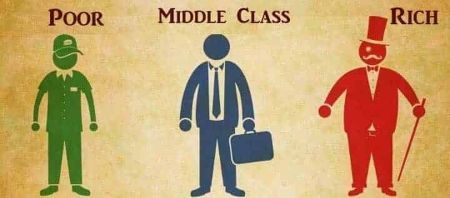
With the turn of the century, however, this situation has worsened. We are living in a time of increasingly precarious wages, and every day more and more people, even with jobs, struggle to make ends meet comfortably. This creates stress and tension in society.
The once abundant middle class is shrinking, the poor are growing, and social polarization is increasing. Political parties on both sides are exploiting this to find scapegoats for the general dissatisfaction, while simultaneously seeking a foothold from which to launch their diatribes against their irreconcilable “enemies.”
Business owners, the vast majority of whom are small and working themselves, receive scant support to grow and foster job creation. Politicians talk a big game about promoting entrepreneurship, but the reality is that they only know how to create obstacles and taxes for those who haven't yet escaped the entrepreneurial rut.
With a society increasingly trivialized by social media, more and more people are thinking less, believing they have every right with hardly any obligations, and are easily manipulated into extreme situations where they express their despair. This also contributes to the prevailing tension.
When I hear talk of polarization and tension, almost no one discusses the causes, and for me, perhaps the most important is the disappearance of the middle class, which acted as a buffer against tension.
The rise in poverty exacerbates all kinds of tensions and brings out the worst in us.
Trying to answer the title of my reflection: Where is the middle class headed?
The answer could be: it's going down the drain.
And as an old Spanish proverb says: everyone killed it, and it died alone.
We will all pay the price, especially the most vulnerable.
 EN
EN  ES
ES