
Views: 0
If there's one concept that torments electric car drivers, it's the dreaded "range anxiety." Some have experienced it firsthand, and others have heard about it: the manufacturer advertises a spectacular range, but reality, with the air conditioning on, the road uphill, and a heavy foot, drastically reduces it.
Today, most electric vehicles (EVs) simply show you the remaining battery percentage or, at best, an estimated range based on recent consumption. But that figure is static and not very useful. It doesn't tell the driver: "With the traffic ahead, the outside temperature, and your driving style, you may or may not reach city X."
This uncertainty is the reason why many drivers "charge just in case," wasting time and not taking full advantage of their lithium-ion battery's actual capacity.
The good news is that science is here to help. Engineers at the University of California, Riverside (UCR), have taken a significant step forward with a new estimation method that promises to eliminate this concern. They've named it State of Mission (SOM).
SOM's approach is radically different from the current one. Instead of just looking at the battery's internal chemistry, it views the entire journey as a dynamic mission to be accomplished.
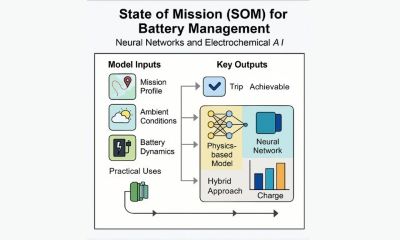
SOM combines two worlds:
. The electrochemical principles of how the lithium-ion battery behaves at the molecular and electrical level in real time.
. Machine Learning: An intelligent component that absorbs and processes in real time all the external factors that actually consume energy:
. Driving Style: Are you aggressive or gentle with the accelerator?
. Environmental Conditions: Outside temperature and altitude.
. Journey Variables: Traffic, road incline, and air conditioning use.
This system is intelligent; It learns from the experience of each trip and is able to instantly recalculate the actual range and probability of success of your mission.
Although this UCR prototype requires significantly more processing power than current production EVs, its potential is immense. It's not close to market, but it lays the groundwork for what electric mobility will be in just a few years.
Imagine the confidence a driver gains from knowing, precisely, that they have enough battery power to reach their destination, thus optimizing charging stops. A similar system will benefit not only cars but also drones and other applications with high-performance batteries.
Researchers are already working on adapting the SOM to promising solid-state and sodium-ion batteries. This is a crucial and relatively quick step that will transform the user experience, making the transition to a 100% electric future much smoother and stress-free.
Manufacturers are undoubtedly taking note, and I don't think it will be long before they offer it to the market. They are the most interested
 EN
EN  ES
ES