
Views: 9
When we think of wind energy, the image that usually comes to mind is the same: enormous steel towers, blades tens of meters long, and large wind farms located in mountains or offshore. These installations are capable of producing enormous amounts of electricity, but they also require significant investments, specialized machinery, and complex infrastructure.
However, not all innovations have to be gigantic to be interesting. Sometimes, the best ideas are precisely the simplest.
That is the case with Wind to Watt, a French company that has developed a wind turbine concept completely different from what we are used to. Its goal is to democratize access to wind energy through a modular, economical, easy-to-transport system that can be installed without the need for large towers or concrete foundations. The company plans to launch its product between the end of this year and the beginning of next year, although it still needs to demonstrate its large-scale commercial and technical viability.
The idea couldn't be simpler. Instead of relying on a heavy metal structure, the system consists of a frame of tubes—which can be made of aluminum or other lightweight materials—covered with surfaces made from recyclable materials. The entire assembly rotates, driven by the wind, to power the electric generator. An image can be seen below.
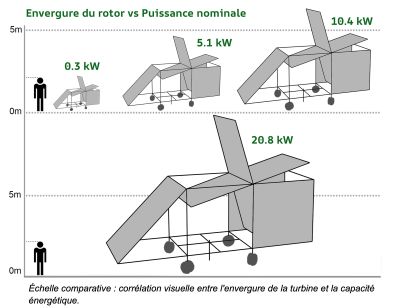
One of the most striking aspects is its scalability. The larger the structure, the greater the power it can produce. This allows the system to be adapted to very different needs, from powering an isolated home to providing electricity to small farms, businesses, construction sites, or facilities located in areas where the electrical grid is not readily available.
Another important advantage is the speed of installation. Since it doesn't require heavy-duty cranes or complex support structures, assembly is much simpler and more economical. Furthermore, its design facilitates transport and dismantling, which is especially useful for temporary applications or in remote areas. According to the company, the system can be installed in just a few hours and configured from a few hundred watts to several kilowatts of power.
Personally, what I liked most about this proposal is precisely its simplicity. In engineering, a maxim generally holds true: the simpler a system is, the less likely it is to breakdown, the lower the maintenance costs tend to be, and the easier it is to manufacture.
Its commitment to sustainability is also noteworthy. The use of recyclable materials and the reduction in civil engineering requirements lessen the environmental impact of the installation compared to conventional wind turbines. Obviously, it is not intended to replace the large wind farms that supply entire cities, but rather to offer a complementary solution for distributed energy generation.
Of course, the most important challenge remains: demonstrating that the system offers good performance, stable production, and a long lifespan under real-world operating conditions. As with any innovation, the market will determine whether it manages to carve out a niche among existing renewable energy solutions.
In any case, initiatives like this demonstrate that innovation isn't always about building bigger machines, but about reframing problems from a different perspective. If an idea manages to make wind energy more accessible, more affordable, and more sustainable, it deserves our full attention.
You can see the company's website at:
https://windtowatt.com/index-en.html
I certainly wish them the best of luck. The wind, and especially the turbine's profitability, will ultimately decide.
 EN
EN  ES
ES