
Views: 16
We currently take for granted that we can connect to the Internet almost anywhere. However, the reality is that millions of people still live in areas where the connection is slow, expensive, or simply nonexistent.
To solve this problem, various technological solutions have emerged: satellites, denser terrestrial networks, and even airborne systems. Among these latter options, an idea is gaining renewed interest: stratospheric Internet.
This involves placing technological platforms at high altitudes—in the stratosphere—that function as floating telecommunications stations. From there, they can provide coverage to large areas of the territory at a potentially lower cost than satellites.
One of the best-known attempts was Project Loon, developed by Google. Its proposal consisted of deploying high-altitude balloons in the stratosphere capable of transmitting Internet signals to areas with poor coverage.
For several years, the system was tested in different countries and even provided connectivity in emergency situations. However, the project had a difficult problem to solve: stratospheric winds.
The balloons were constantly drifting with the air currents. When they moved, so did their coverage area, forcing the launch of more and more balloons to maintain stable service. In the end, the system proved too expensive, and Google decided to cancel it in 2021.
The idea, however, did not disappear. Today, a new generation of systems known as HAPS (High Altitude Platform Stations) is being developed.
Unlike balloons, these platforms are unmanned vehicles capable of hovering virtually motionless in the air for extended periods. They function as a kind of hybrid between a satellite, an aerostat, and a telecommunications tower.
One of the companies making the most progress in this field is Aalto HAPS, which has developed the Zephyr vehicle, an ultralight aircraft powered by solar energy.
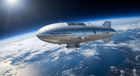
The Zephyr operates using solar panels that power its electric motors and electronic systems. During the day, it generates enough energy to stay airborne and recharge its batteries, which it uses at night.
Its most impressive feature is its ability to hover in a fixed location. In a test conducted last year, this vehicle remained airborne for 67 consecutive days, something unthinkable just a decade ago.
Furthermore, using small electric motors, it can counteract winds and maintain a relatively stable position over a given region. And from that altitude—about 20 kilometers—it can provide telecommunications coverage to a vast area.
The idea is for these platforms to function as floating telecommunications towers, capable of providing 4G or 5G connectivity to mobile phones for users on the ground.
For the end user, the connection would be virtually the same as connecting to a conventional tower.
One of the locations where tests will be conducted soon is Japan, a country made up of more than 6,800 islands. Many of these countries are small and sparsely populated, making the deployment of traditional telecommunications infrastructure very expensive.
This is why Japan is emerging as an ideal testing ground for this type of technology.
The major potential advantage of HAPS systems is cost. Building and launching satellites—like those of Starlink—remains extremely expensive, even though costs are decreasing.
Stratospheric platforms, on the other hand, could offer connectivity up to ten times cheaper, according to estimates from some companies in the sector. Furthermore, because they operate within the atmosphere, they are easier to maintain, upgrade, or recover than a satellite placed in orbit.
Despite its progress, stratospheric internet is still in an early stage of implementation, and several companies are trying to develop it. The technology seems mature, but its large-scale commercial viability has yet to be demonstrated.
If it works as its proponents hope, it could become a key tool for connecting the millions of people who still lack internet access.
The history of technology is full of ideas that took years to find their moment. Perhaps stratospheric internet is one of them.
As always with innovation, time will tell.
 EN
EN  ES
ES