
Views: 22
The debate about whether technology "takes our jobs" is as old as the wheel itself. However, in 2026, the idea of who wins and who loses is becoming obsolete. The real question isn't how many jobs disappear, but how efficiency and innovation transform our society for the better.
New technologies aren't imposed on a whim; they are imposed because they represent undeniable improvements: greater efficiency, lower costs, and, increasingly, a reduced environmental impact. The world doesn't stop to wait for us to be ready. In fact, trying to halt technological advancement to protect a current job is like trying to stop the ocean with your bare hands.
We don't know precisely what jobs will be like in 2040, but we do know that clinging to past industries is a losing battle. The smartest thing to do is adapt as soon as possible, because those who lead the change are always the ones who benefit the most.
Let's look at the example of Amazon and coal. To understand the magnitude of this transition, let's look at the numbers. At its historical peak (1923), coal mining in the US employed around 883,000 people. It was the energy giant that powered the world.
Today, Amazon employs more than 1.1 million people in the United States alone. The "retail giant" is now a more massive employer than the "energy giant" was a century ago. Defending coal for the jobs it represents today makes no logical or economic sense. The market has already chosen a more dynamic path.
Data from the International Energy Agency (IEA) is compelling: since 2021, for the first time in history, more people are working in clean energy than in fossil fuels. This trend is unstoppable.
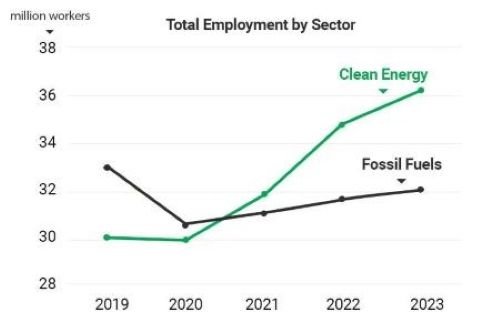
Even in the US, employment in green energy is growing at twice the rate of the rest of the energy sector. Solar installations and energy storage are leading this growth for one compelling reason: they are cheaper and don't pollute. To deny this reality is to ignore the economic evidence.
But we must acknowledge that the human factor is the source of the pain of change. It's easy to talk about "adaptation" from an office or a blog, but we need to be empathetic. We know that behind every statistic of "job loss" there is a person going through a difficult time. The transition to a green economy will be especially tough for countries that depend almost exclusively on oil.
However, the pain of not changing will be even greater. Those who are slow to embrace the transformation will find it much harder to fit into the new global ecosystem. Technology doesn't wait, and although the process may be uncomfortable, the end result is a cleaner, more efficient, and more connected life.
That's life, and that's how human evolution has always been: constant change where resilience is our best tool.
And so it has always been.
 EN
EN  ES
ES