
Views: 27
Fusion energy has been humanity's great energy dream for decades. A virtually unlimited source, with no CO₂ emissions and very little waste. For years it was a distant scientific goal. Today, however, it is also a business race.
Dozens of private companies are competing to be the first to bring fusion from the laboratory to the electrical grid. Some are setting their first commercial reactors for beyond 2030. Others are more ambitious.
One of them is Helion Energy, which has signed a contract with Microsoft to supply it with fusion-generated electricity in 2028. That date no longer sounds far off.
Caution is advised. It is very likely that this contract includes clauses that protect the company in case of delays. In high-risk technology sectors, these types of agreements usually have wide margins.
But it's also true that publicly committing to a multinational the size of Microsoft is no trivial matter. It means putting reputation, credibility, and financial future on the line. In this novel industry, marketing and engineering advance at almost the same pace.
Helion recently announced that it had managed to heat plasma to 150 million degrees Celsius. To put this in context: the Sun's core reaches about 15 million degrees. Fusion on Earth requires much higher temperatures because we don't have the enormous gravitational pressure of the Sun.
The company itself has indicated that its operational target is around 200 million degrees. Achieving and sustaining these conditions stablely is one of the major technological challenges. The challenge is not only generating extreme temperatures, but doing so with stability, control, and a positive energy balance.
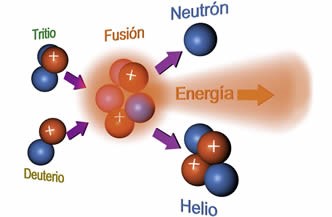
Not all companies follow the same strategy. Some work with tokamak or stellarator reactors, using deuterium and tritium as fuel. In these systems, energy is extracted as heat, which is then converted into electricity by turbines, just like in a conventional power plant.
Helion takes a different approach. It uses deuterium and helium-3, a combination that generates more charged particles. These particles interact with the magnetic fields that confine the plasma, allowing—in theory—electricity to be extracted directly from the process without first converting heat into mechanical energy.
If it works, it would be a more compact and potentially more efficient system. But in science and technology, the "if" carries a lot of weight.
In the last year, several fusion companies have announced funding rounds ranging from $400 million to over $800 million. The money comes from investment funds, large technology corporations, and individual billionaires.
The reason is clear: whoever manages to generate commercial electricity with fusion will see their value multiply exponentially. We're not talking about an incremental improvement, but a structural transformation of the global energy system.
Clean, abundant, and manageable energy would transform industry, transportation, and geopolitics.
Helion has already begun construction of the 50-megawatt reactor it needs to fulfill its agreement with Microsoft. This will be the real test.
Designing on paper is one thing. Building, operating, and delivering electricity continuously is quite another.
Throughout the history of fusion, we've seen many optimistic announcements. The difference now is that the private sector is taking on real economic risks. This accelerates development, but it also increases the pressure.
Fusion is no longer just a government-funded scientific project, like ITER in France. It's also a global business race.
2028 may be too soon. The timeline may shift a few years. But something has changed: money, talent, and ambition are aligned.
All paths can be valid if they lead to a productive outcome. The question is not whether fusion will ever work, but when and who will achieve it first.
And when that happens, the world's energy map will be rewritten.
 EN
EN  ES
ES