
Views: 24
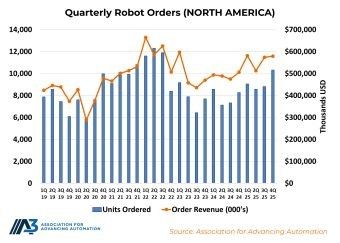
Robotics is experiencing an unprecedented boom. According to a recent report by the Association for Advancing Automation (A3), robot sales in the United States in 2025 reached astonishing figures: a total of 36,766 units sold, valued at $2.25 billion.
This growth, an increase of nearly 7% compared to the previous year, reflects a growing interest among companies in improving their internal processes and optimizing their competitiveness in an increasingly demanding market.
This increase in robot sales highlights a global trend in which robotics and automation are taking a central role in the transformation of industries. Although the automotive sector has traditionally been the leader in this field, an interesting shift has been observed in 2025: the largest robot sales have not gone solely to the automotive industry, but also to general-purpose sectors. This phenomenon highlights how companies across various sectors are integrating robotics into their operations to improve efficiency and reduce costs.
A sales chart can be seen below.
One of the main drivers of this sales increase is the rise of collaborative robots, or "cobots." Unlike traditional robots, cobots are designed to work alongside humans in a safe and efficient work environment. This makes cobots ideal for tasks requiring precision but also direct interaction with employees.
There are diverse applications for cobots, ranging from material handling and welding to inspection and packaging. What sets these robots apart is that, compared to their traditional counterparts, their programming is becoming increasingly intuitive and straightforward. This allows companies to implement robotics solutions more quickly, without requiring advanced technical expertise.
These types of robots are enabling even small and medium-sized enterprises (SMEs) to adopt advanced technologies, improving productivity without the need for large infrastructure investments. Thanks to their flexibility, cobots adapt to a variety of tasks, making them an essential tool for sectors as diverse as manufacturing, logistics, and even food production.
The increase in robot sales reflects a broader trend in which automation is becoming a key driver of competitiveness. Companies that adopt these technological systems not only improve their production processes but can also offer products and services faster, with higher quality, and at a lower cost. This is especially crucial in an increasingly competitive global market, where efficiency and the ability to adapt quickly are key to success.
Although the data published by the A3 corresponds to the US market, it is highly likely that global trends are not very different. Robotics is evolving rapidly, and while the impact may vary by region, the adoption of automated technologies is on the rise in almost every industrial sector. This tells us that we are in an era where robotics will play an increasingly fundamental role in all economic sectors.
Companies that leverage these technological advances will likely be better positioned to face the challenges of the future.
 EN
EN  ES
ES