
Views: 22
Recently, articles have appeared discussing advances in nuclear batteries, something developed over 50 years ago and almost forgotten since then. They began to be used in heart markers, before falling into disuse.
Now they are being researched again, although it's not clear that the market demands them. And I believe the fundamental reason is their ability to power a system for a very long time. Many years.
Unlike lithium batteries, which store chemical energy and run out in hours or days, nuclear batteries generate electricity from the decay of radioactive isotopes. Their lifespan can be 10, 20, or more years without needing to be recharged
Their energy density allows them to provide much more energy in much less space than any current chemical system.
Decades ago, these batteries were enormous and dangerous. But today, companies like the Chinese firm Betavolt are using Nickel-63 isotopes and artificial diamond semiconductors. The diamond acts as a super-efficient energy converter and, at the same time, as a protective shield.
All of this allows for the creation of batteries smaller than a coin, and the emitted radiation is beta radiation, which is so weak that the battery's casing itself completely blocks it. Furthermore, this radiation is so low that it does not affect humans, and the greatest risk arises if it is ingested.
Their safety is very high. Unlike a nuclear reactor, these batteries do not undergo fission or chain reactions. They cannot explode. At the end of their life cycle, the isotopes decompose into stable elements (such as copper) that are not harmful to the environment.
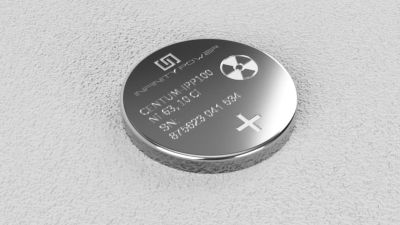
Interest has grown because we now have devices that did not previously exist or that operate in extreme conditions:
. Space Exploration: For probes traveling to areas where sunlight does not reach.
. Remote Sensing (IoT): Sensors on the ocean floor or high in the mountains where it's very difficult to send a technician to change a battery.
. Medical Devices: Pacemakers or implants that don't require surgery every 5 or 10 years to replace the battery.
. Defense and Surveillance: Equipment that must be buried or hidden and function for decades.
With the crisis of materials like lithium and cobalt, major powers are looking for alternatives that don't depend exclusively on rare earth mining. Nuclear batteries offer a path to energy sovereignty for critical devices.
In this technological race for infinite autonomy, we find ourselves at a fascinating moment. Currently, China has a considerable advantage in commercial application, while the West leads in the research of cutting-edge materials.
The drawback of these batteries is their name: nuclear. However, the physics behind these batteries makes them, in theory, much safer than the lithium batteries we use today (which can catch on fire or explode if punctured).
If a nuclear battery (like a nickel-63 and diamond battery) were to break inside your cell phone (for example), this is what would happen:
. There would be no explosion or fire.
. The radiation is very low. Beta particles have a range of only a few millimeters and do not penetrate human skin.
. The risk would be ingestion. If it is inhaled or swallowed.
And when the battery is depleted, the nickel-63 converts into copper-63, which is a stable and completely harmless material.
Although I admit that I wouldn't be the one to put a battery like this in my cell phone. I have grandchildren who swallow all sorts of things.
Which doesn't exclude them from having interesting applications.
And as I always say in these cases, time will tell.
 EN
EN  ES
ES