
Views: 26
Human creativity knows no bounds, and today I'm going to discuss a new process for storing energy and returning it to the grid when needed. The current battery-based system is operational in many places, but batteries require special and scarce metals, while this alternative uses readily available and easily obtainable materials.
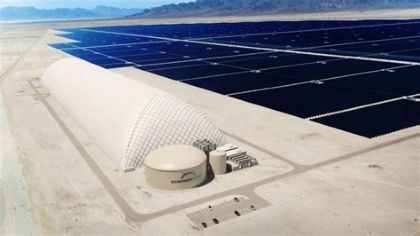
The technology comes from Energy Dome, and it's one of the most ingenious and sustainable solutions for large-scale energy storage. Instead of using expensive chemicals like lithium, it utilizes the physical properties of carbon dioxide (CO₂) to store electricity, much like a giant spring.
It operates in a closed loop (the gas never escapes into the atmosphere) through these three steps:
Phase 1. Charging: Compress and Liquefy
When there is excess solar or wind energy, the system uses that electricity to power a compressor. Then, gaseous CO₂ is extracted from a giant inflatable dome and compressed until it becomes liquid.
This process generates heat, which is not wasted: it is stored in a thermal system (like a giant thermos filled with bricks or hot water).
The liquid CO₂, now cool and very compact, is stored in steel tanks at ambient temperature.
Phase 2. Storage
Unlike conventional batteries that discharge over time, liquid CO₂ can remain in the tanks for days or weeks without losing energy. This makes it ideal for long-term storage (24 hours or more).
Phase 3. Discharge: Expand and Generate
When the grid needs electricity (for example, at night), the process is reversed, and the liquid CO₂ is heated using the heat stored earlier.
As it heats up, the liquid evaporates and turns back into a gas, expanding rapidly. This pressure drives a turbine that generates electricity and sends it to the grid.
Finally, the gas is returned to the inflatable dome to begin the cycle again.
Why is it revolutionary?:
Common materials: It only uses steel, CO₂, and water. It doesn't need rare earth elements or conflict minerals.
Lifespan: It can operate for more than 30 years without losing capacity (lithium batteries degrade quickly).
Efficiency: It returns approximately 75% of the energy it receives, which is extremely high for mechanical systems.
Cost: It is almost 50% cheaper to build than current lithium mega-batteries.
The following video visually explains how the change of state of CO₂ allows for efficient energy management and why it is a key component in reducing our dependence on fossil fuels.
When the sun or wind generates more electricity than the grid can absorb, this is a very practical system for storing surplus electricity and then recovering and sending it back to the grid when there is no sun or wind and it is needed.
Based on current data, the estimated cost per megawatt-hour is $50, which is less than half the cost of batteries, and without relying on supplies from the Far East.
Some plants are already operational, and for more information, you can visit the company's website at: https://energydome.com/
I wish them all the best.
 EN
EN  ES
ES